
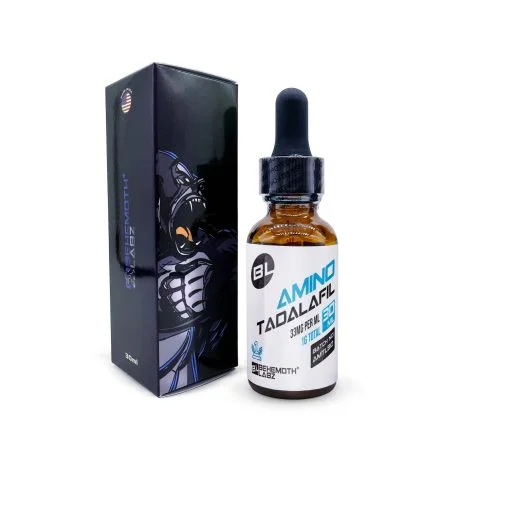


What Is Amino Tadalafil?
Amino tadalafil is a synthetic small-molecule phosphodiesterase type 5 (PDE5) inhibitor and a structural analog of tadalafil, studied in vitro for PDE5 enzyme kinetics and cGMP-signaling research. It is a research compound for laboratory use only. It is not FDA approved for human or veterinary use, and human data remain limited.
Amino tadalafil (aminotadalafil; CAS 385769-84-6) sits within the diketopiperazine-based PDE5 inhibitor class defined by tadalafil. Sold as an amino tadalafil research reference — in lyophilised solid or, from some sources, a tadalafil liquid peptide format — it is used to probe catalytic-site binding, enzyme selectivity across phosphodiesterase isoforms, and second-messenger regulation. It is not a peptide despite the common “amino tadalafil peptide” and “tadalafil peptide” search labels; it is a small molecule. Researchers evaluating amino tadalafil for sale should treat it strictly as a preclinical, in-vitro reference standard.
Disclaimer: Amino Tadalafil is a research compound not approved by the U.S. Food and Drug Administration (FDA) for human or veterinary use. It is not intended to diagnose, treat, cure, or prevent any disease. This product is strictly for laboratory research purposes only.
Amino Tadalafil Research Background
Amino tadalafil derives from the tadalafil chemotype first characterized by Daugan and colleagues, who reported tadalafil (compound 12a) as a highly potent PDE5 inhibitor with an IC50 of roughly 5 nM and high selectivity over PDE1–PDE4 and PDE6 in the Journal of Medicinal Chemistry (Daugan et al., 2003). As a close structural analog, amino tadalafil is examined in comparative enzyme assays and structure–activity relationship (SAR) work that maps how modifications to this scaffold alter binding at the PDE5 catalytic site. It has also been documented in analytical settings as an adulterant reference standard, which is part of why laboratories characterize its molecular identity precisely.
How Does Amino Tadalafil Work? Mechanism of Action
Amino tadalafil is thought to inhibit PDE5, the enzyme that hydrolyzes cyclic guanosine monophosphate (cGMP), as observed in laboratory models; findings are not consistent across all systems. Mechanistically, the compound is studied for how it docks at the PDE5 catalytic pocket.
The interaction is described in sequence: the benzodioxole and fused tetracyclic core orient the molecule within the catalytic site; the compound occupies the cGMP-binding region; and competitive occupancy is thought to slow enzymatic hydrolysis of cGMP in vitro. In experimental systems this is associated with sustained intracellular cGMP, a second messenger connected to smooth-muscle and vascular-tone signaling at the cellular level. The tadalafil scaffold’s reported selectivity for PDE5 over other phosphodiesterase isoforms (Daugan et al., 2003) makes amino tadalafil a useful probe for isoform-selectivity and binding-affinity studies. Effect claims here are mechanistic and hedged; no human outcomes are implied.
Key Research Areas for Amino Tadalafil
| Area of Research | Research Note |
|---|---|
| PDE5 enzyme inhibition | Used as a model compound for enzyme kinetics, catalytic-site binding, and inhibition-constant measurement in vitro; benchmarked against the tadalafil chemotype (Daugan et al., 2003). |
| cGMP signaling pathways | Applied in studies of intracellular cGMP accumulation and downstream second-messenger cascades within cyclic-nucleotide research; the parent chemotype has been examined in rodent models (Sadek et al., 2025). |
| Selectivity, binding & SAR | Investigated in comparative isoform assays and structure–activity relationship work relating functional groups, stereochemistry, and active-site affinity within the diketopiperazine PDE5-inhibitor class. |
Physical, Structural, and Handling Properties
Amino tadalafil is typically supplied as a lyophilised crystalline solid (with some suppliers offering a reconstituted liquid tadalafil format for laboratory handling). It is a small heterocyclic molecule, not a peptide. Its defining physicochemical identifiers are below.
| Property | Value |
|---|---|
| Molecular Formula | C21H18N4O4 |
| Synonyms | Aminotadalafil, amino tadalafil |
| IUPAC Name | (2R,8R)-6-amino-2-(1,3-benzodioxol-5-yl)-3,6,17-triazatetracyclo[8.7.0.0³,⁸.0¹¹,¹⁶]heptadeca-1(10),11,13,15-tetraene-4,7-dione |
| Molecular Weight | 390.4 g/mol |
| CAS Number | 385769-84-6 |
| PubChem CID | 10178467 |
For stability, the lyophilised solid is handled as light- and moisture-sensitive; reconstituted solutions are prepared and stored under controlled laboratory conditions immediately before assay.
How Does Amino Tadalafil Compare to Tadalafil?
Amino tadalafil is a structural analog of tadalafil, differing by an amino substitution on the shared diketopiperazine-based tetracyclic scaffold. Both are studied as PDE5 inhibitors, but the analog is used mainly as a comparative reference in structure–activity and isoform-selectivity research. The table compares definitional and structural attributes only.
| Attribute | Amino Tadalafil | Tadalafil (reference chemotype) |
|---|---|---|
| Compound class | Small-molecule PDE5 inhibitor analog | Small-molecule PDE5 inhibitor |
| Molecular formula / MW | C21H18N4O4 / ~390.4 g/mol | C22H19N3O4 / ~389.4 g/mol |
| Structural difference | Amino substitution on the tetracyclic core | Parent hydantoin/diketopiperazine scaffold |
| PDE5 selectivity (research context) | Studied comparatively; analog data remain limited | Characterized as highly selective, IC50 ~5 nM (Daugan et al., 2003) |
| Research status | Research-use-only reference compound | Research-use-only in this context; not supplied for human use |
Why Do Some Researchers Choose Amino Tadalafil Liquid Over Capsule?
For certain in-vitro workflows, amino tadalafil liquid offers laboratory-handling advantages over an amino tadalafil capsule, though the choice is protocol-dependent and implies no human or veterinary use. The pre-dissolved amino tadalafil liquid is ready for direct volumetric aliquoting, removing the reconstitution or extraction step an amino tadalafil capsule requires. A stated concentration (mg/mL) supports reproducible dilution series and finer control across assay replicates, and a homogeneous solution reduces variability from weighing small solid quantities. The trade-off is stability: the liquid generally has a shorter working shelf life than the capsule’s solid form and requires cold, light-protected storage.
What Are the Risks and Limitations of Amino Tadalafil Research?
This section is mandatory reading before working with Amino Tadalafil in any laboratory setting.
- Handling Precautions: Amino Tadalafil should be handled by trained laboratory personnel only, in a controlled research environment. Use appropriate PPE at all times. Avoid direct skin contact or inhalation of any reconstituted solution.
- Exposure Risks: Amino Tadalafil is a small-molecule PDE5-inhibitor research compound thought to competitively occupy the PDE5 catalytic site and slow cGMP hydrolysis in preclinical models. No human safety data exists for this compound.
- Storage: Store lyophilised Amino Tadalafil at −20 °C in a dry, dark environment. Protect from light, heat, and moisture.
- Toxicity and Data Limitations: No chronic toxicity data exist for Amino Tadalafil. All findings are from short-duration preclinical models only, and evidence for the analog specifically remains limited.
Frequently Asked Questions
How does amino tadalafil work in vitro?
Amino tadalafil is studied for competitive occupancy of the PDE5 catalytic site, which is thought to slow cGMP hydrolysis and sustain intracellular cGMP in laboratory models. It is investigated as an enzyme-kinetics and selectivity probe. Effect data remain limited and are not consistent across all systems.
What is the molecular weight and CAS number of amino tadalafil?
Amino tadalafil has a molecular weight of about 390.4 g/mol, the molecular formula C21H18N4O4, and CAS number 385769-84-6 (PubChem CID 10178467). These are definitional structural identifiers used for analytical verification.
Is amino tadalafil a peptide or a SARM?
No. Despite “amino tadalafil peptide,” “tadalafil peptide,” and “tadalafil SARM” search labels, amino tadalafil is a small-molecule PDE5 inhibitor. It is neither a peptide nor a selective androgen receptor modulator (SARM); those terms describe unrelated compound classes.
How does amino tadalafil compare to tadalafil?
Amino tadalafil is a close structural analog of tadalafil, differing by an amino substitution on the shared tetracyclic scaffold. Tadalafil itself is characterized as a highly selective PDE5 inhibitor; the analog is used comparatively in SAR and isoform-selectivity research. Comparative data for the analog remain limited.
Is amino tadalafil approved for human use?
No. Amino tadalafil is a research compound not approved by the FDA for human or veterinary use. It is not intended to diagnose, treat, cure, or prevent any disease and is supplied strictly for laboratory, in-vitro, and analytical research.
How should amino tadalafil be stored?
Store the lyophilised solid at −20 °C, protected from light, heat, and moisture. Reconstitute only under controlled laboratory conditions immediately before use, and follow institutional handling and disposal protocols.
What to Look for in a Supplier When Sourcing Research-Grade Amino Tadalafil?
Check that every batch is independently third-party tested for purity and identity, and that a Certificate of Analysis (COA) is available for each lot. Prefer suppliers that sell strictly for preclinical and in-vitro research use and that publish sourcing documentation supporting reproducibility. You can consider verified suppliers such as Behemoth Labz, where compounds are supplied strictly for preclinical and in-vitro research use, manufactured under controlled laboratory conditions with batch-level analytical verification.
Note: All products referenced are strictly for LABORATORY AND RESEARCH PURPOSES ONLY. They are not to be used for any human or veterinary purposes.
References
- Daugan, A., et al. (2003). The discovery of tadalafil: a novel and highly selective PDE5 inhibitor. 2. Journal of Medicinal Chemistry, 46(21), 4533–4542. https://pubmed.ncbi.nlm.nih.gov/14521415/
- Sadek, A. A., et al. (2025). Potential of tadalafil and tadalafil-cellulose nanocomposite in preventing postsurgical abdominal adhesions in a rat cecal abrasion model. Scientific Reports, 15(1), 31210. https://www.nature.com/articles/s41598-025-14894-0
ATTENTION:</b This content is for LABORATORY AND RESEARCH PURPOSES ONLY. Not for human or veterinary use. Educational purpose only. No human consumption.
1st Party COA

3rd Party COA

Related products
SARMS

SARM liquids

SARMS
SARMS


SARM liquids

Liquids